From Chiang Mai to the world: introducing Sam Yan Global Fellow Navinthiti Jarupratai
Supporting emerging civic leaders through research, storytelling, and international exchange.
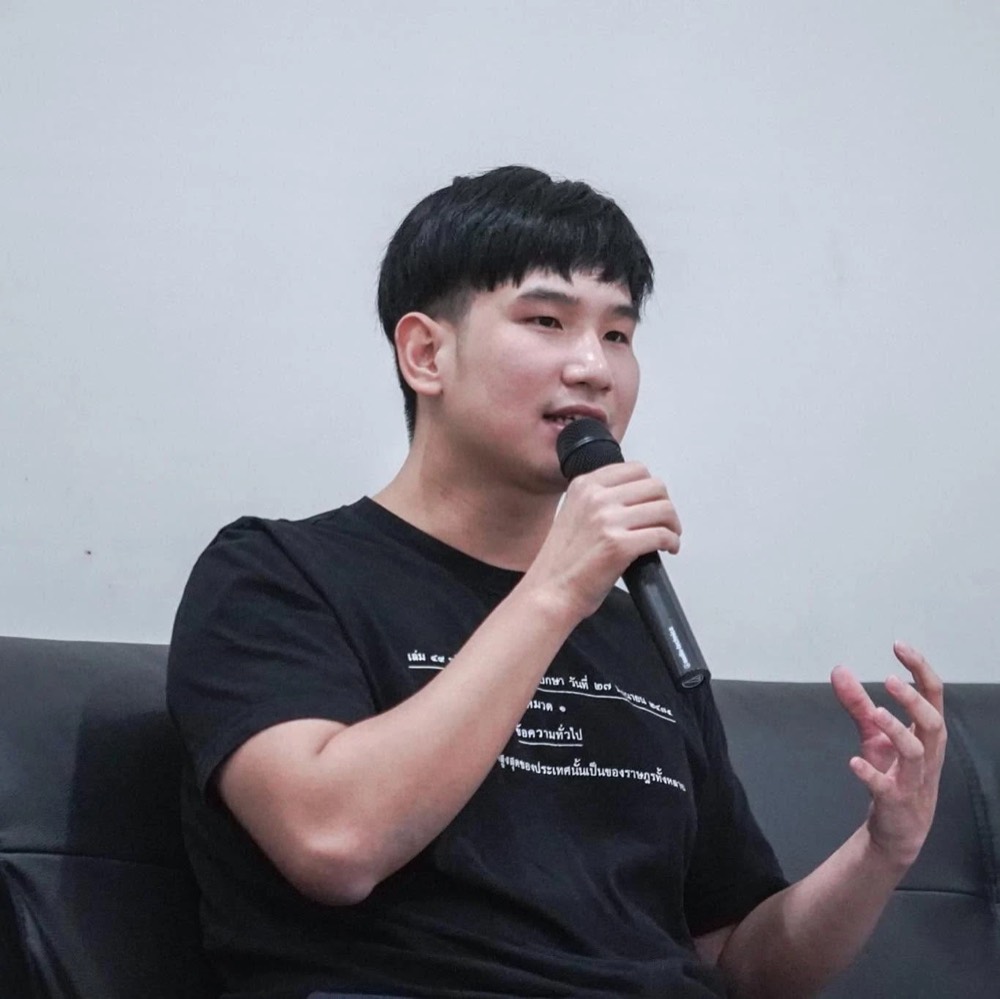
- Fellow
- Navinthiti Jarupratai
- Based
- Chiang Mai
- Supported
- Manuscript and documentary
- Travelling
- New York and Harvard, November 2026
Navinthiti Jarupratai joins the Institute as a Sam Yan Global Fellow. He is in his sixth year of medical school at Chiang Mai University and has spent most of those years organising, which is the reason he is here. The Fellowship exists for people whose activism, scholarship and creative work have already converged on one question, and who are doing that work a long way from the institutions that would otherwise notice them.
He began organising in 2020, during Thailand's student-led democratic awakening. On the Chiang Mai University Student Council he ran campaigns and petitions for democratic governance of the university, for student participation in the decisions that concerned students, and for the freedom to say so out loud.
Then came Ang Kaew. Navinthiti joined architects, students and community advocates in a campaign to keep one of the university's earliest buildings, a dormitory, standing. They lost, and it was demolished. The campaign left a question behind it that the university has not answered: who is consulted before an institution decides which parts of its own history to remove, and what accountability can mean once the decision is already made.
The same question followed him into medicine. He interned at the Mae Tao Clinic, founded by Dr Cynthia Maung on the Thai–Myanmar border to treat displaced people, migrants and communities no state is counting, and he has since worked with clinics serving migrant workers whom the healthcare system turns away. Hierarchy does real work in a teaching hospital. It settles who may speak on a ward round, whose judgement is written down as judgement, and whose pain is written down at all.
Who holds power, whose knowledge counts, and whose voice is treated as worth hearing.
The Fellowship is backing two pieces of work. The first is a manuscript reading power, hierarchy and institutional culture in medical schools and hospitals through medical anthropology — the discipline that treats a ward as a social order rather than a neutral room. The second is a documentary, co-directed with Sam Yan Studio, on the Ang Kaew campaign and on the wider argument at Chiang Mai University about expression, participation and what a university owes the people who live inside it.
In November 2026 he travels to the United States with the Institute's support to present the documentary work and join discussions at New York University and at Harvard. We are using the trip to put him in front of scholars, researchers, students and organisers working on social justice, medical anthropology, healthcare advocacy and freedom of expression. The screenings are the occasion; the people in the room afterwards are the point.
A fellowship, for us, is not a flight. Across Thailand young activists, researchers and organisers produce work that never reaches a mentor, a publisher, a budget or a reader outside the country. The Global Fellowship takes one project, funds it, edits it, programmes it, and carries it as far as it will go. A manuscript becomes a book that unsettles what a profession assumes about itself. A documentary keeps a history an institution would rather mislay. A fortnight of meetings abroad turns into collaborations that run for years.
Navinthiti's work holds university democracy, heritage, medical training and healthcare inequality in a single grip, because all four turn on who is allowed to decide. We welcome him to the Fellowship — and we welcome universities, foundations and civil society organisations who want to see more of this built.